
MDCAT 2026: Confirmed Date, Registration & Everything You Need to Know
MDCAT 2026 is confirmed for Sunday, 16 August 2026 — and if you’re a pre-medical student in Pakistan, the clock is now genuinely tight. Registration is running at the national PMDC portal, the syllabus is set, and the exam falls much earlier this year than in 2025. Here’s the complete, up-to-date guide: the confirmed dates, fee, eligibility, paper pattern, syllabus, and exactly how to apply — with the official facts, not the rumours.
When is MDCAT 2026 and how do I register? MDCAT 2026 will be held nationwide on Sunday, 16 August 2026 at 10:00 AM, conducted by the Pakistan Medical & Dental Council (PMDC). Registration is online and centralised at mdcat.pmdc.pk using your CNIC. PMDC extended the deadlines to 13 July (regular) and 18 July (late), with a fee of Rs 9,000 (regular) or Rs 13,000 (late).
Because deadlines have already been extended once, always confirm the latest dates directly on pmdc.pk before you rely on any figure — including the ones here.
The confirmed MDCAT 2026 dates
PMDC announced the date in a public notice dated 19 May 2026. The key dates:
- Exam day: Sunday, 16 August 2026, 10:00 AM, held across Pakistan on the same day.
- Registration opened: 22 June 2026.
- Regular deadline: extended to 13 July 2026.
- Late deadline (with late fee): extended to 18 July 2026.
One thing every 2026 candidate should register mentally: this exam is far earlier than last year. MDCAT 2025 ended up being held on 26 October after a flood-related postponement, so the 2026 batch effectively has around ten fewer weeks to prepare. With most educational boards wrapping up their exams by around 20 July, many students have roughly four focused weeks before test day. Start now.
How to register for MDCAT 2026
Registration is entirely online and national — there is one portal for the whole country:
- Go to the official portal at mdcat.pmdc.pk.
- Create your account and register using your CNIC (or B-Form).
- Enter your personal, academic, and contact details carefully — incorrect or incomplete information can get your application rejected.
- Select your test city/centre. Note: once selected, the centre cannot be changed.
- Pay the fee online (card or bank challan) and save your payment proof.
You do not register on any university’s website, no matter what a Facebook group or WhatsApp message tells you. The only registration route is the PMDC portal.
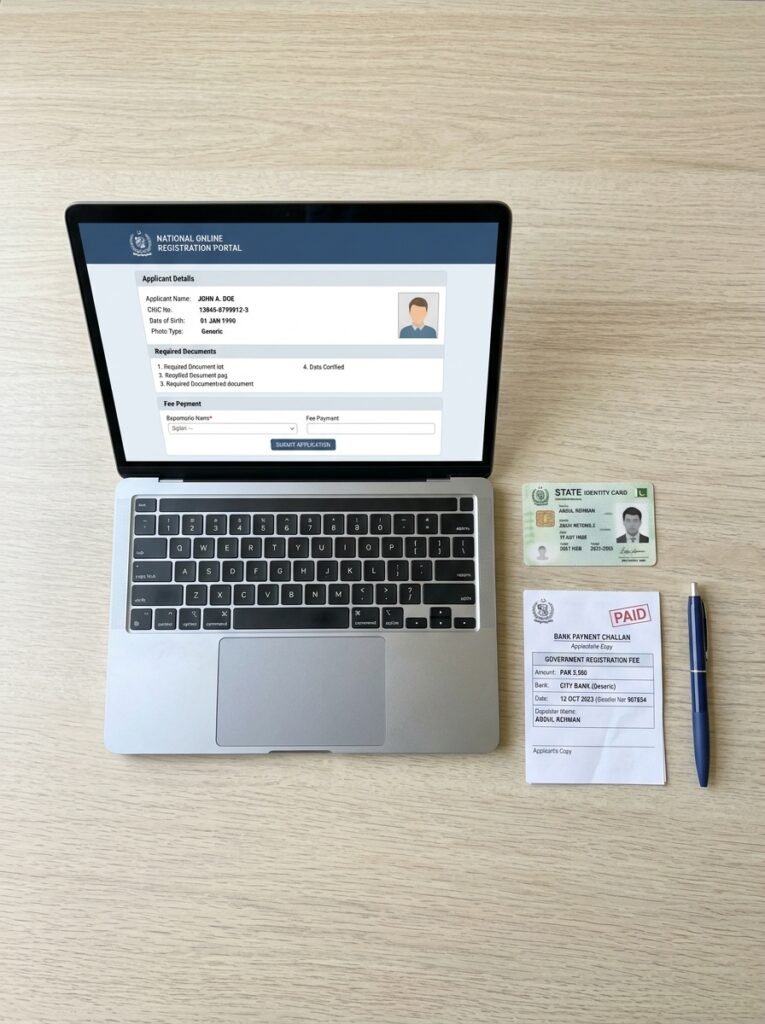
MDCAT 2026 fee
PMDC’s confirmed 2026 fee structure:
- Pakistan test centres: Rs 9,000 (regular) / Rs 13,000 (late).
- International centre (Riyadh): Rs 45,000 (regular) / Rs 55,000 (late).
All fees are non-refundable and non-transferable, so double-check every detail before paying.
Who conducts MDCAT 2026 in each province
PMDC sets the policy and the single national paper, but designated provincial universities administer the test and run the public-college admissions afterwards. For 2026:
- Punjab: University of Health Sciences (UHS), Lahore.
- Sindh: Sukkur IBA University. (Older guides still naming Dow or JSMU are out of date — for 2026 it’s Sukkur IBA.)
- Khyber Pakhtunkhwa: Khyber Medical University (KMU), Peshawar.
- ICT, AJK, Gilgit-Baltistan and the Riyadh centre: Shaheed Zulfiqar Ali Bhutto Medical University (SZABMU), Islamabad.
After completing PMDC registration, follow the instructions of your relevant conducting university for centre and admission details.
MDCAT 2026 eligibility
The requirements are mainly academic:
- Marks: a minimum of 65% in FSc Pre-Medical (or equivalent) for MBBS, and 60% for BDS. (Verify the current threshold on PMDC, as it was tightened from 60%.)
- Subjects: Biology and Chemistry are mandatory, plus Physics or Mathematics.
- Foreign qualifications: Cambridge O/A-Level students need an IBCC equivalence certificate before registering.
- Results awaiting: students whose FSc results are still pending may register and appear, but results must be verified before college admission.
- No age limit and no attempt limit — repeaters apply through the same process alongside fresh candidates.
- Provincial domicile rule (2026): PMDC has been enforcing provincial alignment — your matriculation, intermediate, and domicile should be from the same province. If your documents span provinces, contact PMDC to confirm your status before registering.
MDCAT 2026 paper pattern
The exam is 180 MCQs with no negative marking — so attempt every question. The subject breakdown:
- Biology: 81 MCQs (45%)
- Chemistry: 45 MCQs (25%)
- Physics: 36 MCQs (20%)
- English: 9 MCQs (5%)
- Logical Reasoning: 9 MCQs (5%)
The exam is conducted in English. On duration and format there’s some variation in what different prep sites report (roughly three to three-and-a-half hours, and paper-based in most provinces), so confirm the exact timing and whether your centre is paper-based or computer-based with your conducting university before exam day.
The takeaway from the weightings is strategic: Biology and Chemistry together are 70% of the paper. Strong performance in those two subjects alone largely decides pass or fail, while Physics separates the competitive scorers. English and Logical Reasoning are small but easy marks you shouldn’t neglect.
MDCAT 2026 syllabus
Good news for planning: PMDC has confirmed that the MDCAT 2025 curriculum/syllabus applies to MDCAT 2026 — there’s no new syllabus shift. The chapter-wise topics, weightages, and 180-MCQ pattern from 2025 remain in force, all based on the FSc Pre-Medical curriculum.
Treat the official PMDC syllabus as your single source of truth. If a topic isn’t in it, it isn’t on the exam — so don’t waste time on outside material.
How your merit is calculated
Your MDCAT score matters more than your entire school record. Under the Admissions Regulations, public and private college merit is calculated as:
- 50% MDCAT + 40% HSSC/FSc + 10% SSC/Matric.
Half your merit number comes from one morning in August — which is exactly why focused MDCAT preparation outweighs everything else at this stage.
A realistic 4-week study plan
With limited time, prioritise ruthlessly:
- Weeks 1–2: Cover Biology and Chemistry thoroughly first — they’re 70% of the paper. Within Biology, front-load high-yield areas like cell biology, genetics, and human physiology.
- Week 3: Lock in Physics concepts and numericals, and do a quick pass on English grammar/vocabulary and Logical Reasoning patterns.
- Week 4: Full-length, timed mock tests — simulate the real exam, then spend most of your review time on the topics you keep getting wrong, not the ones you already know.
- Throughout: Practise a steady volume of MCQs daily. MDCAT rewards recall under time pressure, so reading alone isn’t enough. Pick one trusted resource and finish it rather than juggling five books.
Don’t get scammed — trust only official sources
MDCAT season is peak season for misinformation. Every year, fake notices, wrong dates, “leaked papers,” and fake WhatsApp/helpline numbers circulate widely — and PMDC has publicly warned students against relying on unofficial social-media information. Keep yourself safe with one simple rule: if it isn’t on pmdc.pk or your conducting university’s official site, treat it as a rumour — including screenshots that look official. No one can sell you a real MDCAT paper, and anyone claiming to is scamming you.
A note on NUMS and AKU
If you’re targeting NUMS-affiliated medical colleges, you’ll need a separate NUMS-MDCAT registration at nums.edu.pk — it has its own pattern. Aga Khan University (AKU) also runs its own separate entrance test. You can register for and sit more than one, so plan strategically.
Key Takeaways
- MDCAT 2026 is on Sunday, 16 August 2026 at 10:00 AM, conducted by PMDC nationwide.
- Register online at mdcat.pmdc.pk using your CNIC; regular deadline extended to 13 July, late to 18 July (verify on pmdc.pk).
- Fee: Rs 9,000 regular / Rs 13,000 late (Pakistan centres) — non-refundable.
- Eligibility: ~65% FSc Pre-Medical for MBBS (60% BDS); Biology + Chemistry mandatory; provincial domicile alignment applies.
- Pattern: 180 MCQs, no negative marking — Biology 81, Chemistry 45, Physics 36, English 9, Logical Reasoning 9.
- Syllabus: the MDCAT 2025 curriculum applies; merit = 50% MDCAT + 40% FSc + 10% Matric.
- Trust only pmdc.pk and your conducting university — ignore fake notices and “leaked” papers.
also read: https://freeblink.shop/pakistan-salary-tax-2026-27/
FAQ
Q1. When is MDCAT 2026? MDCAT 2026 will be held nationwide on Sunday, 16 August 2026 at 10:00 AM, as confirmed by PMDC’s public notice dated 19 May 2026. It’s earlier than the 2025 exam, so candidates have less preparation time than last year’s batch.
Q2. What is the last date to register for MDCAT 2026? PMDC extended the registration deadlines to 13 July 2026 (regular fee) and 18 July 2026 (late fee). Because deadlines have already been extended once, always check pmdc.pk for the latest confirmed date before relying on it.
Q3. How do I register for MDCAT 2026? Registration is online and national at mdcat.pmdc.pk using your CNIC. You do not register on any university website. Enter your details carefully, select your centre (which can’t be changed later), pay the fee, and save your payment proof.