Government Employees Salary Increase 2026-27: What the Budget Actually Means for Your Pay
The government employees salary increase 2026-27 is now confirmed, and the short answer is this: federal employees from BPS-1 to BPS-22 are getting a 7 percent raise, pensioners are getting a matching 7 percent increase, and two old ad hoc allowances are being merged into basic pay — a change that quietly matters more than the headline number. All of it takes effect from July 1, 2026.
On this page
- Government Employees Salary Increase 2026-27: What the Budget Actually Means for Your Pay
- Key Takeaways
- What the budget confirmed on June 12
- The five parts of the salary package
- Why the allowance merger matters more than the 7%
- The new basic pay scales (RBPS-2026): what we know
- Punjab employees: a different pension number this year
- The income tax cut — relief from the second direction
- Minimum wage and the bigger picture
- When does it hit your salary slip?
- Quick summary
- FAQ Section
- How much is the government employees salary increase for 2026-27?
- Is the pension increase also 7 percent?
- What is RBPS-2026?
- Why does the allowance merger matter?
But the 7 percent figure alone hides the real story. Depending on your grade, your province, and your monthly income, your actual take-home gain could be more — or less — than 7 percent. This guide breaks down every part of the package in plain language, so you know exactly what lands in your account from next month.
Key Takeaways
- Federal government employees (BPS-1 to BPS-22) receive a 7% ad hoc relief allowance on basic pay, effective July 1, 2026.
- Pensions rise 7% for federal retirees.
- The 2022 (15%) and 2025 (10%) ad hoc relief allowances are merged into basic pay, permanently raising the pensionable base — arguably the most important long-term change.
- Punjab announced a 7% salary increase but only a 3.5% pension increase — the two figures do not match this year.
- Income tax was cut across four salary slabs and the high-income surcharge was abolished, so many employees gain from two directions at once.
- The minimum wage rose 10% to Rs 40,700 per month.
- Final grade-wise rupee figures await the official RBPS-2026 notification from the Finance Division.
What the budget confirmed on June 12
Finance Minister Muhammad Aurangzeb presented the federal budget for fiscal year 2026-27 in the National Assembly on June 12, 2026, with a total outlay of roughly Rs 17.57 trillion, as reported by multiple outlets including Dawn and Geo. Inside that budget sat the relief package that millions of public-sector workers had been waiting for.
According to Dunya News and Pakistan Observer, the federal cabinet approved a 7 percent increase in both salaries and pensions ahead of the budget speech. That 7 percent applies to all federal employees from the lowest grade to the highest, and to retirees drawing federal pensions.
The five parts of the salary package
Most coverage stops at “7 percent.” In reality, the federal compensation change for 2026-27 has several moving parts, and each affects a different group:
- A 7% ad hoc relief allowance on basic pay for all grades.
- A merger of two old ad hoc allowances into basic pay — the 15% relief from 2022 and the 10% relief from 2025, as confirmed by Dunya News and others. This is the structurally important one (more on it below).
- A 7% pension increase for federal retirees.
- A Disparity Reduction Allowance for eligible employee categories, and a higher conveyance allowance, attributed by the Associated Press of Pakistan to the Finance Secretary in mid-June.
- Income tax relief, which lowers the deduction at source — effectively adding to take-home pay without changing gross salary.
When you stack the higher gross salary on top of a lower tax deduction, the combined effect for grade-17-and-above officers is bigger than the 7 percent headline suggests.
Why the allowance merger matters more than the 7%
Here is the part that experienced government employees should read twice.
For years, governments added “ad hoc relief allowances” on top of basic pay instead of revising the pay scales themselves. The problem: many of these allowances did not count toward your pension, which is calculated on basic pay. So your gross salary grew, but your future pension base lagged behind.
The 2026-27 budget merges the 2022 and 2025 ad hoc allowances into basic pay. This means your pensionable basic pay rises permanently — and the fresh 7 percent is then added on top of that already-higher figure, not the old pre-merger number.
In practical terms: an employee who retires in 2027, 2028 or later will have their pension calculated on the merged, higher basic pay. Pension analysts have long noted that the basic-pay link is the single most valuable long-term benefit of government service, and this merger strengthens it. So even if the 7 percent feels modest today, the merger is doing quiet, lasting work in the background.
That said, be honest with your expectations: not every past allowance was absorbed. The merger handled the 2022 and 2025 reliefs, but other allowances remain outside basic pay. Your pensionable base is higher than before — just not as high as your full gross salary.
The new basic pay scales (RBPS-2026): what we know
The revised pay structure for 2026-27 is being called RBPS-2026 (Revised Basic Pay Scales 2026). Because the 2022 and 2025 allowances are folding into basic pay, the entire BPS-1 to BPS-22 chart is being reissued with new basic-pay figures.
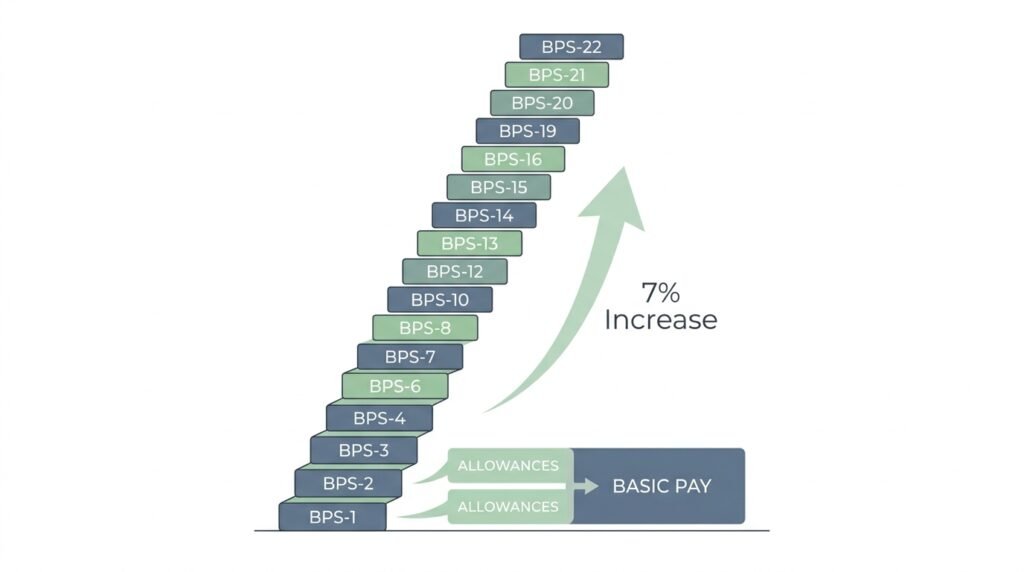
An important honesty note: the exact grade-by-grade rupee figures are not officially gazetted yet. The Finance Division publishes the official RBPS-2026 notification only after the Finance Bill 2026 is passed by the National Assembly. Any “final” grade-wise chart circulating before that is an estimate, not a confirmed circular.
What you can rely on right now:
- The percentage (7% ad hoc relief on basic pay) is confirmed.
- The merger of 2022 and 2025 allowances into basic pay is confirmed.
- The effective date (July 1, 2026) is confirmed.
- The exact new basic-pay rupee value for your grade should be confirmed against the official Finance Division circular once it is issued — not against unofficial charts.
If you want a single rule of thumb: take your current basic pay, recognise that the 2022 and 2025 allowances now sit inside it, and apply 7 percent on top. Treat any number more precise than that as provisional until the gazette lands.
Also Read: NESCOM Hospital Islamabad Jobs 2026
Punjab employees: a different pension number this year
If you are a Punjab government employee, your numbers come from the provincial budget, not the federal one.
Punjab Finance Minister Mujtaba Shuja-ur-Rehman presented the provincial budget on June 16, 2026, with a total outlay above Rs 5.85 trillion, as reported by Daily Pakistan and Dawn. Punjab announced:
- A 7% salary increase for all government employees (matching the federal rate).
- A 3.5% pension increase — which is half the federal 7 percent.
This is the detail many people miss: the Punjab pension increase does not match the federal pension increase this year. Federal retirees drawing pension through AGPR receive the federal rate regardless of where they live; Punjab provincial pensioners receive 3.5 percent.
It is also the first time in three budget cycles that both Punjab figures dropped year-on-year — salary fell from 10% to 7%, and pension from 5% to 3.5%. The reason, per provincial coverage, is the tighter IMF fiscal framework, which lowered the federal benchmark and limited every province’s room on current spending.
The income tax cut — relief from the second direction
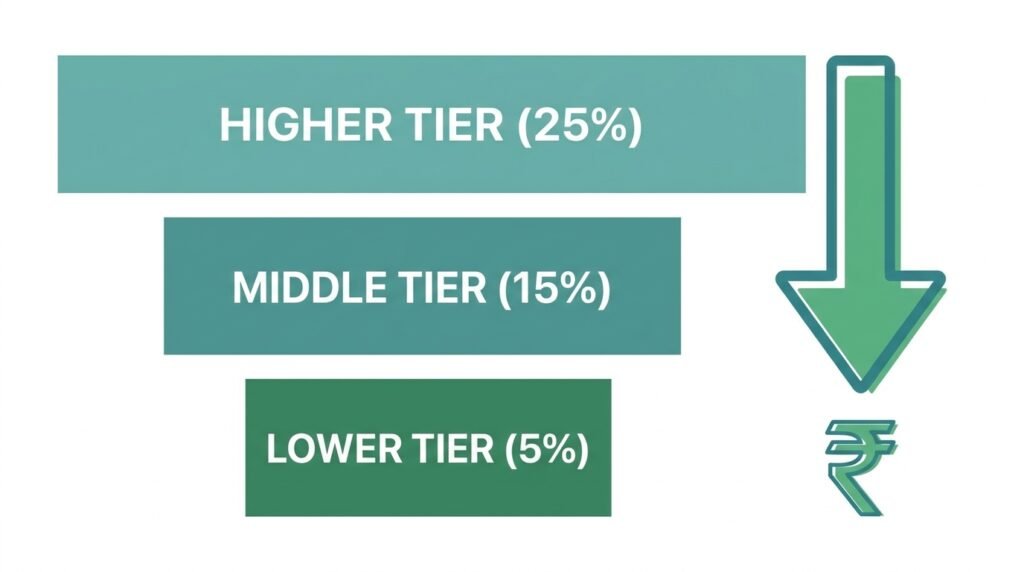
Here is the good news that applies to government and private employees alike. The budget restructured income tax slabs for the salaried class and abolished the surcharge, effective July 1, 2026.
According to Dawn and The Express Tribune, the changes include:
- The slab structure was expanded from six bands to eight.
- The rate on annual income between Rs 2.2m and Rs 3.2m fell from 23% to 20%.
- The rate on Rs 3.2m to Rs 4.1m dropped from 30% to 25%.
- The top 35% rate, which previously started at Rs 4.1m, now applies only above Rs 7m, with new intermediate bands (25%, 29%, 32%) filling the gap.
- The 9% surcharge on annual income above Rs 10m was abolished.
- The tax-free threshold stayed at Rs 600,000 a year (about Rs 50,000 a month), and the bottom three slabs were left unchanged.
What this means in real money (figures attributed to Dawn’s and cssprep’s published calculations):
- If you earn up to roughly Rs 183,000 a month, the bottom slabs are unchanged — you see no tax change.
- An employee on Rs 200,000 a month saves a modest amount each month from the rate cut.
- An employee on Rs 400,000 a month sees a noticeably larger monthly saving, because the relief is concentrated in the middle and upper slabs and because the surcharge is gone.
The pattern is clear: the higher your taxable income (up to the new Rs 7m ceiling for the top rate), the more the tax cut adds to your take-home pay — on top of the 7 percent raise.
Minimum wage and the bigger picture
For the lowest earners, the budget raised the federal minimum wage by 10 percent — from Rs 37,000 to Rs 40,700 a month, an increase of Rs 3,700, as reported by Geo and others. This applies to unskilled private-sector workers under the Minimum Wages Ordinance and sets the wage floor across sectors.
Now for the honest context. A 7 percent raise needs to be read against inflation. Coverage of the Economic Survey 2025-26 put recent inflation in the high-single to double-digit range, meaning the real purchasing-power gain from a 7 percent raise is modest once rising prices are accounted for. The merger and the tax cut soften that, but it is fair to say this is a relief package built inside tight IMF constraints rather than a generous across-the-board increase.
When does it hit your salary slip?
All of the above — the 7 percent, the merged allowances, the new tax slabs — is effective from July 1, 2026, the start of the new fiscal year. Employers and payroll departments apply the revised withholding rates from that date.
One caution worth repeating: until the Finance Bill 2026 is formally passed by the National Assembly and the Finance Division issues the RBPS-2026 circular, the precise grade-wise basic-pay figures remain proposals. The direction and the percentages are confirmed; the last decimal point of your new basic pay is best checked against the official notification when it appears. After July, review your first revised pay slip and compare it line by line.
Quick summary
The government employees salary increase 2026-27 is a 7 percent raise that is worth slightly more than it looks — because two old allowances are folding into basic pay (lifting your pension base) and because a separate income tax cut lowers your deduction at source. Punjab employees get the same 7 percent salary but only 3.5 percent on pensions. The minimum wage rose to Rs 40,700. And the exact grade-wise chart should be confirmed from the official Finance Division circular, not from unofficial tables, once the Finance Bill is passed.
If you are a job seeker rather than a serving employee, the takeaway is just as relevant: government service in 2026-27 still carries a stronger long-term pension benefit thanks to the basic-pay merger — one more reason public-sector roles remain in demand.
Also Read: Join Pakistan Army as Captain 2026
FAQ Section
-
How much is the government employees salary increase for 2026-27?
Federal government employees from BPS-1 to BPS-22 receive a 7 percent ad hoc relief allowance on basic pay, confirmed in the June 12, 2026 budget and effective July 1, 2026.
-
Is the pension increase also 7 percent?
For federal pensioners, yes — a 7 percent increase. Punjab provincial pensioners, however, received only a 3.5 percent increase this year, announced in the provincial budget on June 16, 2026.
-
What is RBPS-2026?
RBPS-2026 stands for Revised Basic Pay Scales 2026. The 2022 and 2025 ad hoc relief allowances are being merged into basic pay, so the BPS-1 to BPS-22 chart is reissued. The official grade-wise figures are published by the Finance Division after the Finance Bill is passed.
-
Why does the allowance merger matter?
Pension is calculated on basic pay. By merging the old allowances into basic pay, the budget permanently raises your pensionable base, which increases the pension of anyone retiring in 2027 or later.
-
Did income tax also change for salaried employees?Yes. Four salary slabs got lower rates, the surcharge on high incomes was abolished, and the top 35 percent rate now starts at Rs 7 million instead of Rs 4.1 million. The Rs 600,000 tax-free threshold was unchanged.
-
When do the new salary and tax changes take effect?
All changes are effective July 1, 2026, the start of fiscal year 2026-27. Final figures remain proposals under the Finance Bill 2026 until approved by the National Assembly.




1 thought on “Government Salary Increase 2026–27: Pay & Pension Guide”