
Germany’s DAAD Scholarship 2027 Is Open for Pakistanis — and the First Deadline Is Weeks Away
If a fully funded master’s or PhD in Germany is on your list, the clock has already started. Germany’s DAAD scholarship portal is open for the 2027 cycle, and one of the biggest deadlines — 31 August 2026 — is only weeks away. This is the moment to get your documents in order, not next month.
But here’s the part most posts get wrong: “the DAAD scholarship” isn’t one scholarship with one deadline. It’s a whole family of programmes, each with its own dates, its own rules, and its own way of applying. Miss that distinction and you can easily apply to the wrong thing — or miss a deadline that was never the one you thought it was. This guide sorts it out clearly.
What is the DAAD Scholarship 2027? DAAD (the German Academic Exchange Service) runs a family of fully funded German scholarships for international graduates — including Pakistanis — covering master’s, PhD, and research programmes. The DAAD portal is open now, with a key deadline of 31 August 2026 for several Foreign-Office-funded programme lines. Stipend, tuition support, insurance, and travel are typically covered, but exact deadlines vary by programme.
DAAD isn’t one scholarship — it’s many
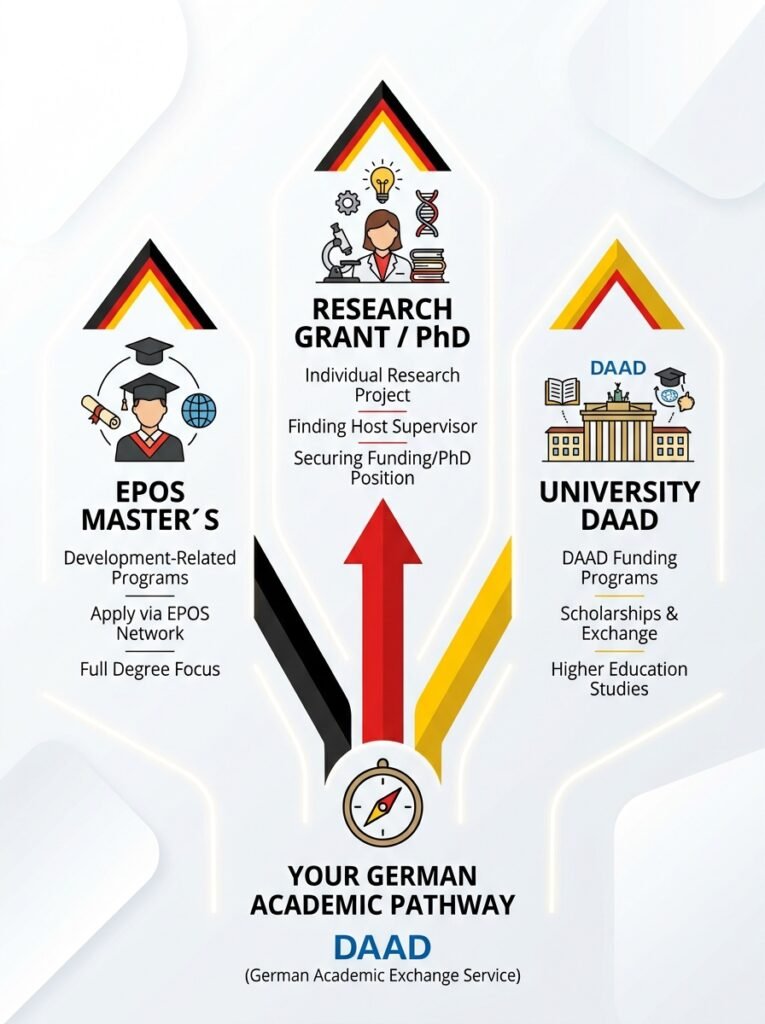
The single most useful thing to understand before you apply: DAAD funds several different programme lines, and you pick the one that fits your stage and field. According to DAAD Pakistan’s own materials, the main routes for Pakistani applicants are:
- EPOS (Development-Related Postgraduate Courses) — master’s scholarships tied to a fixed list of German study programmes, usually requiring a couple of years of relevant work experience.
- Research Grants / Doctoral Programmes — for PhD and research stays in Germany, several funded by the German Federal Foreign Office.
- University-specific DAAD scholarships — for example, a University of Göttingen DAAD scholarship for 2027 master’s and PhD entrants.
They overlap in spirit (fully funded, prestigious, competitive) but differ completely in deadlines and application method — which is exactly why blindly copying a random “DAAD deadline 2027” from social media is risky.
DAAD Scholarship 2027 deadlines you need to know
Deadlines depend on the programme, so treat the list below as a map — then confirm the exact date on the official programme page before you rely on it.
- 31 August 2026 — a key deadline for several DAAD programme lines funded by the German Federal Foreign Office (doctoral programmes and research grants), with the DAAD portal open now. Selection follows in early 2027.
- 23 September 2026 — another DAAD scholarship-database deadline, with selection in January 2027 and funding starting later in 2027.
- Around October–December 2026 — typical window for EPOS development-related master’s courses aiming at the autumn 2027 intake; each EPOS programme sets its own date (one example, the MSc Environmental Governance, lists mid-October 2026).
- 15 November 2026 — the University of Göttingen DAAD scholarship 2027 deadline reported for international master’s and PhD applicants.
Because DAAD and individual universities update these dates every cycle, the golden rule is simple: verify the deadline on daad.pk or daad.de before you plan around it.
What the DAAD Scholarship covers
DAAD scholarships are among the most generous out there, which is a big part of why they’re so competitive. A typical DAAD award includes a monthly living stipend, health/accident insurance, and often travel and study/research allowances. Recently announced figures for the 2027 cycle put the master’s stipend at roughly €934 per month and the doctoral stipend at about €1,300 per month — but DAAD revises these rates periodically, so confirm the current amount on the official DAAD site rather than trusting a number in a forwarded message.
Crucially, many German public universities charge little to no tuition, and DAAD scholars are typically supported through their study period, sometimes with funded German-language courses before studies begin. That combination — low tuition plus a real stipend — is what makes Germany one of the strongest value destinations for Pakistani students.
Who is eligible (2027)
Eligibility varies by programme line, but the common threads are:
- A completed, relevant university degree — a bachelor’s for master’s-level scholarships, and a master’s for PhD/research grants.
- A strong academic record — DAAD looks for above-average results, and weak grades are a common reason applications are rejected.
- Work experience (for EPOS) — development-related master’s courses usually expect around two years of relevant professional experience, and lean toward applicants from developing countries who plan to apply their skills back home.
- Language proficiency — English or German, depending on the programme. Many English-medium master’s programmes (especially in STEM and business) don’t require German, though German skills add value.
If you don’t meet these yet, that’s useful information now — you can spend this cycle building the missing piece (experience, a language certificate, a stronger CV) and apply competitively next year.
How to apply for the DAAD Scholarship 2027
The application route depends on the programme — this trips up a lot of applicants:
- Pick your programme line first. Decide whether you fit EPOS (master’s + work experience), a research grant/doctoral programme, or a university-specific DAAD scholarship. This decides everything else.
- For research grants / doctoral programmes: apply through the DAAD portal directly for the relevant programme line, ahead of the stated deadline (for example, 31 August 2026 for the Foreign-Office-funded lines).
- For EPOS master’s: this is usually a university-first process — you apply to the specific German university/programme on DAAD’s EPOS list, and if your application is strong, the university nominates you for DAAD funding. You do not send EPOS applications straight to DAAD.
- Prepare your document set (below) and submit online before the deadline. Late or incomplete applications are simply not considered.
- Track and follow up through the portal or the university, and watch for interview or clarification requests.
Documents you’ll typically need
Have these ready in clean, scanned form well before the deadline:
- Completed DAAD/university application form
- Updated CV/resume (DAAD format where required)
- Motivation letter and, for research, a research plan or proposal
- Two recommendation/reference letters
- Academic transcripts and degree certificates
- Proof of English or German language proficiency
- Valid passport or national ID (CNIC)
A thin CV or a weak, generic motivation letter is one of the most common reasons strong-on-paper candidates get rejected — so give these real time.
Avoiding scams and misinformation (read this)
This is a high-demand topic, and that attracts bad actors and careless “news” pages. Protect yourself:
- Use official sources only. DAAD’s Pakistan site is daad.pk and the global site is daad.de. Cross-check every deadline and figure there.
- Don’t trust deadlines from random blogs or social posts. Several aggregator sites currently publish inconsistent or clearly garbled DAAD dates. If a deadline isn’t on an official DAAD or university page, don’t plan around it.
- DAAD does not ask you to pay an “application fee” through third parties or agents. If someone demands money to “secure” or “guarantee” a DAAD scholarship, it’s a scam.
- There’s a real DAAD Information Centre in Islamabad for genuine, free guidance — use official channels for personalised questions rather than paid “consultants” who promise results.
No legitimate scholarship can be guaranteed by anyone. DAAD is competitive and selection is on merit.
Who this scholarship isn’t for
Being honest saves you time. DAAD may not fit — at least this cycle — if you haven’t yet completed a relevant degree, if you’re targeting EPOS but have no relevant work experience, if you can’t meet the English/German language requirement, or if you’re unable or unwilling to relocate to Germany for the full programme. In those cases, either address the gap before applying or look at other options (like Chevening for the UK or Erasmus Mundus for the EU) that may suit your profile better right now.
Tips to strengthen your DAAD application
- Start the motivation letter early and tailor it tightly to the specific programme and to your development/career goals.
- Line up recommenders now — good letters take time, and rushed ones read as generic.
- Get your language certificate sorted before the deadline, not after.
- For EPOS, show a clear “why this course, why Germany, why me — and how I’ll use it back home” thread throughout.
Key Takeaways
- The DAAD Scholarship 2027 portal is open, with a major deadline of 31 August 2026 for several programme lines — act now.
- DAAD is many programmes (EPOS master’s, research grants/doctoral, university-specific), each with its own deadline and application route.
- Awards are fully funded — stipend, insurance, often travel — with reported 2027 figures around €934/month (master’s) and €1,300/month (PhD); confirm current rates on daad.de.
- EPOS is university-first; research grants go through the DAAD portal.
- Verify everything on daad.pk / daad.de and ignore unofficial deadlines — and remember DAAD never charges a fee through agents.
FAQ
Q1: Is the DAAD Scholarship fully funded? Yes. DAAD scholarships typically cover a monthly living stipend, health and accident insurance, and often travel and study allowances, while many German public universities charge little or no tuition. Exact benefits depend on the programme line.
Q2: What is the DAAD Scholarship deadline for 2027? It depends on the programme. A key deadline for several Foreign-Office-funded DAAD lines is 31 August 2026, with the portal open now; other database deadlines include 23 September 2026, EPOS master’s courses generally close around October–December 2026, and some university-specific DAAD scholarships (like the University of Göttingen) are reported to close around 15 November 2026. Always confirm on daad.de.
Q3: Can Pakistani students apply for the DAAD Scholarship? Yes. Pakistan is an eligible country, and DAAD even has an Information Centre in Islamabad. Pakistani graduates can apply for EPOS master’s scholarships, research grants and doctoral programmes, and various university-specific DAAD scholarships, provided they meet the eligibility criteria.