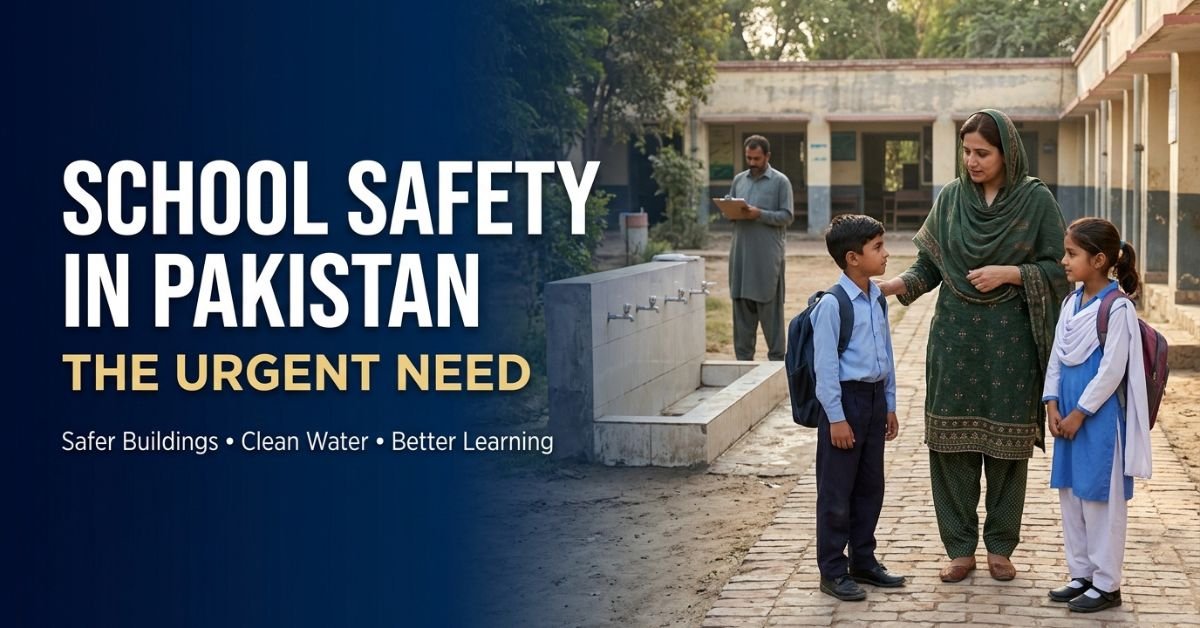
A school building should support learning from the moment a child enters its gate. Classrooms need to be comfortable, toilets usable, drinking water available, and movement around the premises safe. When these basic conditions fail, teachers and pupils spend part of the day managing problems that should already have been addressed.
On this page
- What Infrastructure Checks Reveal About School Safety In Pakistan
- School Building Safety Starts With Assessment
- Everyday Facilities Deserve A Safety Budget
- A Practical Table For Identifying Infrastructure Gaps
- Disaster-Resilient Schools Must Reflect Local Hazards
- What Retrofitting Can Achieve
- Emergency Preparedness Depends On The Building
- Accessibility, Privacy, And Safe Movement Belong Together
- Who Should Be Responsible For Improvements?
- Funding Should Follow Risk And Verified Need
- A School Safety Checklist For Parents And Management
- An Action Plan For Better Educational Infrastructure
- Key Takeaways
- Frequently Asked Questions
- Can Parents Ask About A School’s Building Assessments?
- Does A New School Building Still Need Regular Maintenance?
The discussion about school safety in Pakistan raises questions that matter to families worldwide. How should older buildings be maintained? Which repairs deserve priority? Who checks whether essential facilities still work? What happens when classrooms become temporarily unusable?
Although the title focuses on Pakistan, the principles in this article apply across countries. Schools operate under different budgets, climates, and regulations, but every community benefits from buildings that are suitable for children and managed responsibly.
Quick Answer
Safer educational infrastructure combines sound buildings, functioning water and sanitation, accessible spaces, clear emergency routes, and dependable maintenance. Schools should identify hazards, assign responsibility, arrange qualified assessments when necessary, and verify repairs. The objective is to keep learning spaces usable and safe throughout their working life.
What Infrastructure Checks Reveal About School Safety In Pakistan
School infrastructure is often described through a list of assets: classrooms, toilets, boundary walls, electricity connections, and water points. Such a list provides a starting point, but it does not explain how well a school works.
A classroom may exist while remaining too uncomfortable to use during part of the year. A toilet block may be complete but lack water or privacy. A gate may look secure while creating difficulties during arrival, departure, or an emergency.
A useful assessment therefore considers condition, functionality, and access together.
| Infrastructure Area | Basic Question | More Useful Follow-Up |
|---|---|---|
| Classrooms | Are teaching rooms available? | Are they suitable for the number and needs of pupils using them? |
| Drinking water | Is there a water point? | Is the supply dependable, maintained, and appropriately checked? |
| Toilets | Have toilets been installed? | Are they clean, private, accessible, and working? |
| Electricity | Is the school connected? | Are installations maintained and visible defects addressed? |
| Access routes | Can pupils enter the premises? | Can all pupils move safely between essential facilities? |
This distinction helps schools avoid treating construction as the finish line.
A completed facility becomes useful through daily operation. Someone must notice when it fails, arrange a response, and check that the problem has been resolved. Without that routine, an impressive inventory can conceal an unreliable learning environment.
School Building Safety Starts With Assessment
Buildings change over time. Roofs weather, drainage systems become blocked, fittings loosen, and repeated water entry can create persistent maintenance problems. Alterations may also change how a building is used.
School staff should have a straightforward way to report concerns. These might include falling material, visible movement, recurring leaks, or damage following an incident. Reporting an observation does not require staff to diagnose its cause.
Structural judgments belong to qualified professionals. A teacher, parent, or administrator should not be expected to decide whether a damaged roof can safely remain in use.
Where an immediate danger is suspected, the school should restrict access and seek appropriate assistance. Moving pupils away from a questionable area is a protective response while the concern receives competent attention.
Assessments also need to reflect actual use. A room originally intended for a small group may later accommodate considerably more pupils. Storage areas may become classrooms, or equipment may be added to a roof.
Keeping records of assessments, alterations, and repairs helps future managers understand the building. Safety should not depend entirely on the memory of one employee.
Everyday Facilities Deserve A Safety Budget
A school needs more than a construction budget. It also needs money for cleaning, servicing, replacement parts, and small repairs.
Water systems illustrate the point. A tank, pump, or connection is only part of the service. Storage arrangements, cleaning responsibilities, supply interruptions, and appropriate quality checks also need attention.
Toilets require an equally practical approach. Doors, locks, taps, drainage, lighting, and cleaning materials all affect whether children can use them comfortably.
Privacy deserves particular consideration. Older pupils may need menstrual hygiene arrangements, while younger children may require fittings suited to their size and level of independence.
Electrical installations should receive competent maintenance. Staff should report damaged switches, exposed cables, or other visible concerns rather than improvise repairs.
Furniture belongs in the same conversation. Unstable desks, sharp edges, broken chairs, and crowded layouts can interfere with everyday movement and concentration.
These needs may appear modest compared with a new building, but they determine how a school functions between major projects. A protected maintenance allowance gives managers a way to address them before small failures accumulate.
A Practical Table For Identifying Infrastructure Gaps
Finding a problem is only the beginning. The school also needs to decide who will respond, what expertise is required, and how completion will be checked.
A simple issue register can connect those stages.
| Area | Observation To Record | Appropriate Next Step | Completion Check |
|---|---|---|---|
| Building condition | Location and nature of visible damage | Seek qualified assessment where needed | Confirm that assessment findings have been addressed |
| Water supply | Interruptions, leaks, or storage concerns | Review the supply and maintenance arrangements | Check reliable operation and relevant quality records |
| Toilets | Broken fittings, missing privacy, or cleaning failures | Assign repairs and operational improvements | Inspect during normal school use |
| Electrical systems | Visible damage or recurring faults | Arrange competent inspection and repair | Obtain appropriate confirmation of completed work |
| Movement routes | Obstructions, uneven surfaces, or difficult access | Remove hazards and review the layout | Walk the route with its intended users |
| Emergency arrangements | Unclear routes or unsuitable assembly areas | Review plans against the actual premises | Record observations from an appropriate exercise |
The register should distinguish unresolved concerns from completed work. A maintenance request marked “sent” is not the same as a repair marked “verified.”
Recurring faults deserve additional attention. If the same corridor floods repeatedly, clearing the water each time may leave the underlying drainage issue untouched.
A useful system makes such patterns visible. It also gives managers a clearer explanation of why a particular repair or assessment needs funding.
Disaster-Resilient Schools Must Reflect Local Hazards
Schools in different locations need different solutions. A coastal community, a mountain settlement, and a densely built city neighbourhood may have very different exposures and access constraints.
The same principle applies within a single country. A standard building plan may provide a useful starting point, but the site still needs careful consideration.
Flood-related planning may involve drainage, access, water entry, and the location of vulnerable equipment. Earthquake-related concerns require appropriate structural expertise. Areas exposed to intense heat need particular attention to shade, ventilation, water, and indoor conditions.
These decisions should be informed by local knowledge and competent technical advice.
Resilience also includes recovery. A school should consider how quickly essential services could be restored after disruption and whether alternative learning arrangements are realistic.
Storage matters here too. Teaching materials, records, and equipment should be managed with foreseeable hazards in mind.
No building can eliminate every possible risk. The practical objective is to understand likely problems, reduce avoidable exposure, and prepare for interruptions without assuming that every school needs an identical package of work.
What Retrofitting Can Achieve
Retrofitting means making appropriate improvements to an existing building or its systems. Depending on professional findings, a project might address structural performance, drainage, accessibility, ventilation, or essential services.
For some schools, rehabilitation can preserve useful space while correcting significant weaknesses. For others, replacement or relocation may be the more suitable option.
That decision needs more than a comparison of initial prices. Managers should consider the expected life of the improved building, future maintenance, suitability for teaching, and disruption during the work.
Construction itself requires planning. Children should be separated from work areas, tools, stored materials, excavations, and temporary services. Contractors need arrangements suited to an occupied school environment.
Where the school cannot operate safely during a project, alternative accommodation or scheduling may be necessary.
Completion should include a proper handover. School leaders need to understand what was changed, how new components should be maintained, and which documents must be retained.
A repaired building should enter a continuing maintenance programme. Otherwise, the conditions that contributed to deterioration may gradually return.
Emergency Preparedness Depends On The Building
Emergency plans need to work in real spaces with real pupils.
A route drawn on paper may pass through a doorway that is difficult to open. An assembly location may become unsuitable during certain weather conditions. A corridor may be clear during an inspection but crowded with furniture during ordinary lessons.
Schools should review these details as part of daily management.
Staff need clear responsibilities for communication, pupil accounting, assistance, and contact with families. Arrangements should include younger children, visitors, and anyone who may need additional support.
Different hazards require different responses, so procedures should follow competent local guidance.
Exercises should be calm, age-appropriate, and purposeful. Their value lies in what the school learns. If instructions cannot be heard or a route proves difficult to use, those findings should lead to changes.
Equipment also needs maintenance and appropriate training.
The aim is to build familiarity without frightening children or giving them adult responsibilities. Pupils should understand how to listen, move appropriately, and seek help, while adults remain responsible for planning and protection.
Accessibility, Privacy, And Safe Movement Belong Together
Accessibility is a connected experience. A child may enter through an accessible gate but still face steps outside the classroom or a toilet that cannot be used independently.
Schools should examine routes between entrances, teaching rooms, toilets, water points, shared spaces, and emergency arrangements.
This review benefits from the participation of pupils and families who encounter barriers directly. Their observations can reveal problems that are easy to overlook during a general walkthrough.
Privacy is another part of usable infrastructure. Toilet doors should close properly, changing needs should be considered where relevant, and facilities should protect children’s dignity.
Movement around the school deserves attention too. Bags, furniture, storage boxes, and poorly placed equipment can narrow otherwise suitable spaces.
Arrival and departure may require separate arrangements where vehicles and pedestrians share limited space.
Security measures should be considered alongside access and emergency movement. A controlled entrance needs to support the school’s wider safety arrangements.
An inclusive school is one that can be used in practice. Individual features should be assessed by how well they connect, rather than counted in isolation.
Who Should Be Responsible For Improvements?
Infrastructure problems often persist when responsibility is unclear. Teachers assume management has reported an issue, management expects a contractor to respond, and families receive no update.
A clear allocation of roles reduces this uncertainty.
The following table is a suggested management model. Actual duties depend on local regulations, ownership, employment arrangements, and the nature of the concern.
| Group | Practical Responsibility | Useful Evidence |
|---|---|---|
| School leadership or owner | Record concerns, arrange follow-up, and communicate significant issues | Issue register and action updates |
| Relevant education authority or governing body | Provide oversight and respond within its responsibilities | Inspection and funding records |
| Qualified professionals | Assess specialist concerns and advise on appropriate work | Written findings and recommendations |
| Maintenance staff and contractors | Complete authorized work competently | Work records and handover documents |
| Teachers and other staff | Report everyday problems and follow agreed procedures | Dated observations and incident reports |
| Parents and school councils | Share concerns and review progress constructively | Meeting notes and tracked questions |
Reporting should be simple enough for people to use. A school does not need an elaborate digital platform to assign a repair and record its completion.
What matters is continuity: the concern should remain visible until it receives a suitable response.
Children should also have an age-appropriate way to raise everyday problems without embarrassment or fear of being dismissed.
Funding Should Follow Risk And Verified Need
Schools rarely have enough money to complete every desirable project immediately. That makes prioritization necessary.
The seriousness of a concern, the number of people exposed, professional findings, and the consequences of delay should inform decisions.
An urgent safety issue needs a different response from an improvement intended mainly to refresh appearance. Both may deserve attention, but they should not compete as if they carry the same consequences.
A practical budget separates immediate protective action, recurring maintenance, and larger rehabilitation or expansion.
Maintenance funding should cover the small items that keep services dependable. Without it, managers may postpone inexpensive work until the eventual repair becomes more disruptive.
Procurement should describe the required outcome clearly. Materials, workmanship, supervision, maintenance needs, and acceptance checks all affect value.
Transparency helps families and governing bodies understand decisions. A brief explanation of the problem, proposed work, expected cost, and completion status is often more useful than a broad announcement about infrastructure spending.
Community support can contribute to improvements, but essential safety responsibilities should remain clearly assigned to the responsible institutions.
A School Safety Checklist For Parents And Management
Parents can contribute without attempting technical inspections. Their role is to ask how the school identifies concerns and follows them through.
Answers should identify actions and responsible people. “We are looking into it” may be a starting response, but an unresolved issue needs a clearer next step.
Photographs can document some visible changes. They cannot establish structural adequacy, the quality of hidden work, or drinking-water quality.
Good communication recognizes those limits while giving families meaningful information about progress.
An Action Plan For Better Educational Infrastructure
Start with a usable baseline. Record the facilities, known defects, relevant professional findings, and important local hazards. Identify missing information rather than filling gaps with assumptions.
Address immediate exposure. Where danger is suspected, restrict access and obtain appropriate advice. Arrange suitable alternatives for affected activities.
Assign responsibility. Give each open issue an owner, a next step, and a timeframe that reflects its urgency.
Plan the work. Confirm the necessary expertise, funding, supervision, and arrangements for keeping children away from construction activity.
Verify completion. Check that the repair works as intended. Obtain specialist confirmation where the nature of the work requires it.
Maintain the improvement. Record servicing needs, cleaning arrangements, replacement parts, and future review dates.
Learn from repetition. Investigate recurring faults rather than repeatedly closing the same complaint after a temporary repair.
This sequence makes improvement manageable. It also helps school leaders explain progress without claiming that a single inspection or construction project has solved every infrastructure need.
Key Takeaways
- School safety depends on the condition and daily usability of facilities.
- Building concerns require appropriate professional assessment.
- Water, toilets, electricity, and furniture need continuing maintenance.
- Local hazards should shape infrastructure decisions.
- Accessibility should connect the whole school environment.
- Every unresolved issue needs responsibility and follow-through.
- Completed work should be verified and maintained.
Frequently Asked Questions
Can Parents Ask About A School’s Building Assessments?
Parents can ask management what assessments have been completed, whether concerns remain unresolved, and how follow-up is handled. Access to particular documents depends on the relevant arrangements and local requirements. Clear communication should explain the school’s response without treating a general assurance as technical evidence.
Does A New School Building Still Need Regular Maintenance?
Yes. New buildings also need cleaning, servicing, inspection, and repairs. Drains can become blocked, fittings can break, and services can fail during normal use. Maintenance arrangements should begin when the building enters use, with clear responsibility for its components.
Should Public And Private Schools Use Similar Safety Principles?
The basic objectives apply to both: suitable premises, functioning facilities, accessible spaces, and practical preparedness. Oversight and funding arrangements may differ. Families should ask about the actual management of safety rather than assuming that ownership or fees establish building quality.
Can Temporary Classrooms Provide Suitable Learning Space?
Temporary accommodation may support learning when it is appropriately selected, assessed, equipped, and managed. It still needs suitable access, sanitation, water, comfort, and emergency arrangements. Its temporary status should also remain visible in planning so that an interim solution does not continue without review.
How Can Schools Improve Infrastructure With Limited Resources?
They can begin with an honest assessment, address urgent concerns, protect routine maintenance funding, and organize larger work in stages. Better records can help demonstrate need and avoid repeated spending on temporary fixes. Limited resources make clear prioritization more valuable, but they do not remove the need for competent advice.